

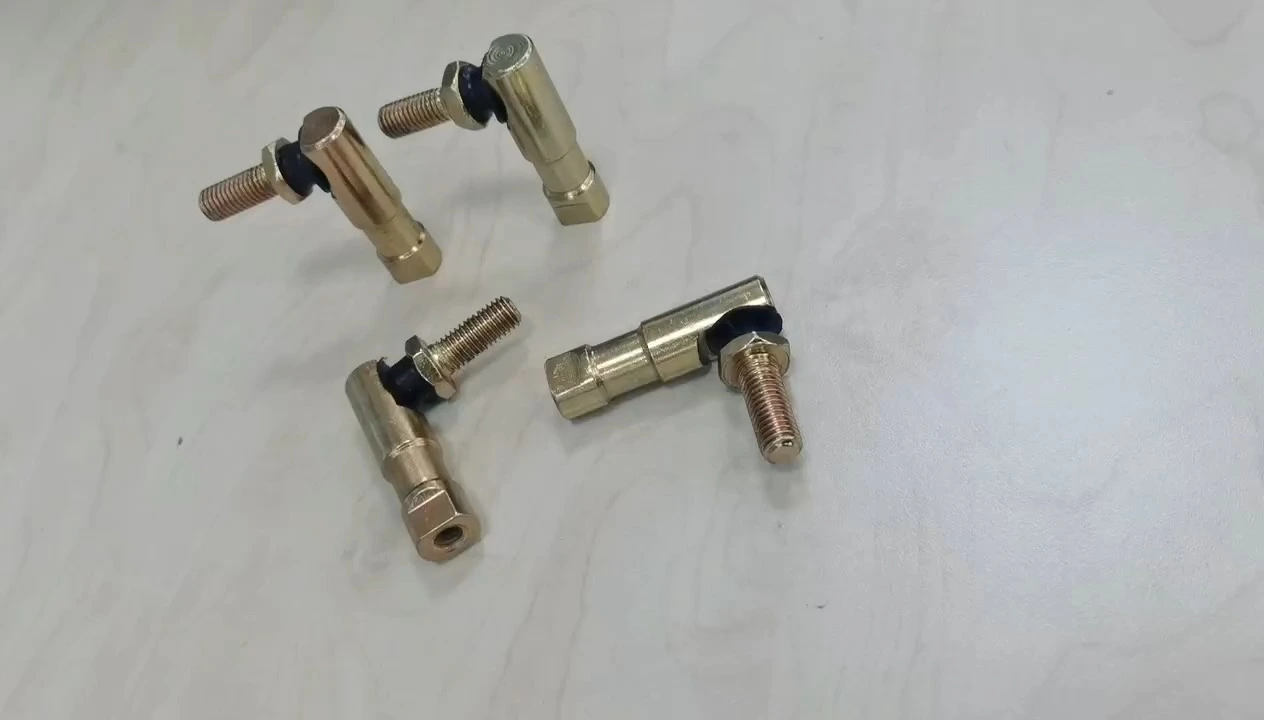
Heavy-Duty Yellow Zinc Plated Angled Ball Joint With Threaded Stud
Product Description:
The heavy-duty angled ball joint with threaded stud is a high-performance mechanical linkage component designed for applications requiring precise motion transfer, durability, and flexibility in confined or offset installations.
Manufactured from high-strength steel and finished with yellow zinc plating, this ball joint offers excellent corrosion resistance and long-lasting performance in demanding environments. Ideal for tight-clearance applications such as steering systems, tie rods, and machine control linkages, this ball joint is pre-lubricated for maintenance-free performance, ensuring consistent, quiet operation across an extended service life. It is a cost-effective, heavy-duty solution for agricultural, industrial, and automotive machinery requiring reliable articulation and force transmission.
Specifications
| Certificate: | IATF16949 |
| Brand: | PHIDIX |
| Type: | Ball Joint |
| Female Thread: | M8×1.25R |
| Male Thread: | M10×1.5R |
| Free Sample: | Available |
| Material: | Carbon steel |
| Surface Treatment: | Yellow Zinc Plated (Gold Finish) |
| Maintenance: | Maintenance-Free |
| Seal Type: | Rubber Dust Boot |
| Thread Type: | Metric Or UNF (Customizable) |
| Load Capacity: | Medium To Heavy-Duty |
| Mounting Style: | Threaded Connection |
Applications
● Agricultural Machinery: Tractors, harvesters, balers, and implement control linkages
● Lawn & Garden Equipment: Ride-on mowers, tillers, and utility vehicle tie rods/draglinks
● Industrial Machinery: Small-engine controls, conveyor systems, and precision motion assemblies
● Automotive & Off-Road: Light-duty steering systems, ATV/UTV tie rod ends, and suspension linkages
● Specialized Machinery: Compact mechanical controls, robotics, and material handling equipment with limited clearance
Advantages
● Excellent durability under dynamic and repetitive loads
● Corrosion-resistant for outdoor and harsh environments
● Reduced maintenance and longer service intervals
● Reliable performance with minimal wear
● Versatile compatibility across various linkage systems