


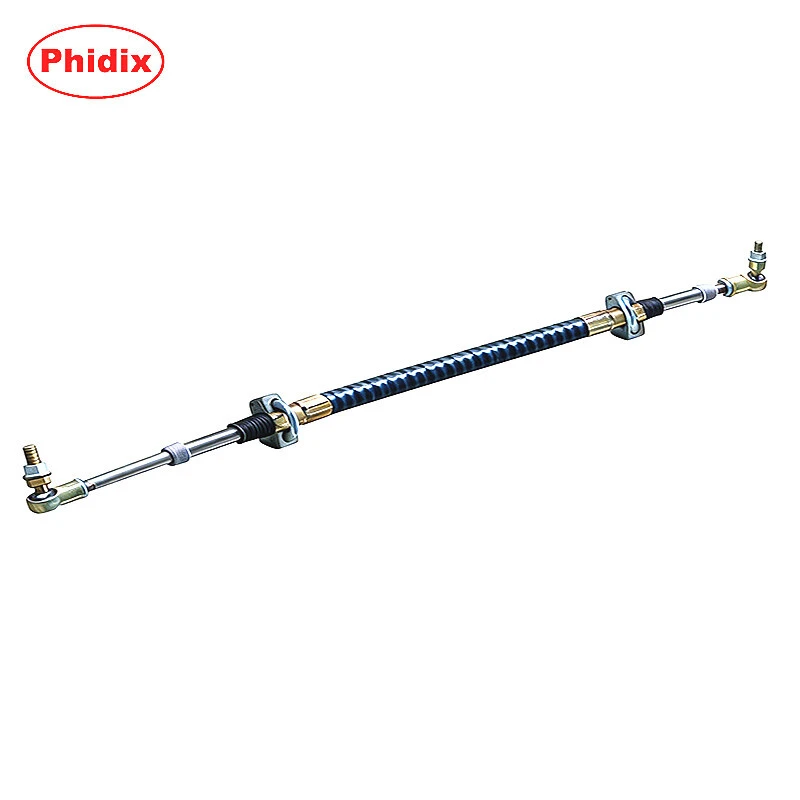
Push-Pull Standard Control Cable Assembly–Bristow / Utility / Low Friction / Low Friction EXT Configurations
Product Description:
The push-pull standard control cable assembly is a precision-engineered mechanical control solution designed to transmit linear motion accurately and reliably across long distances in a variety of mechanical systems. Built for durability and smooth operation, this cable series ensures consistent performance in demanding applications, including throttle control, PTO/4WD engagement, transmission actuation, and remote disconnect mechanisms. The product line offers four structural options—Bristow, Utility, Low Friction EXT, and Low Friction—allowing users to choose the right combination of flexibility, efficiency, and structural integrity for their specific application. Available in both imported (green) and domestic (black, gray, or green) versions, these cables maintain consistent internal specifications and full compatibility across models, ensuring seamless integration and dependable performance.
Specifications
| Certificate: | IATF16949 |
| Brand: | PHIDIX |
| Structural Options: | Bristow, Utility, Low Friction EXT, Low Friction |
| Outer Conduit Material: | PVC, Nylon, or Teflon (Low Friction options) |
| Inner Cable Material: | High Strength Carbon Steel / Stainless Steel |
| Cable Length: | Customizable |
| Travel / Stroke: | Customizable |
| Operating Load: | Depends on cable configuration |
| Operating Temperature: | -40°C to +120°C |
Applications
● Throttle control systems
● PTO and 4WD engagement
● Transmission actuation and gear shifting
● Remote battery or electrical disconnect systems
● Industrial machinery control
● Agricultural equipment
● Marine and off-road vehicles
Features
● High-precision push-pull motion transmission over long distances
● Multiple structural options for flexibility, efficiency, and strength
● Durable inner cable and protective outer conduit for long service life
● Imported and domestic compatibility with consistent internal specs
● Smooth, low-friction operation for reliable mechanical control
● Customizable lengths and stroke to fit diverse systems
Working Principle
Push-pull control cables operate by transmitting linear motion through an inner wire inside a stationary conduit. When an operator moves a lever or handle, the inner cable slides inside the conduit, pushing or pulling the connected mechanical component.


